Virtual CISO New Zealand: Strategic Security Leadership and Assurance

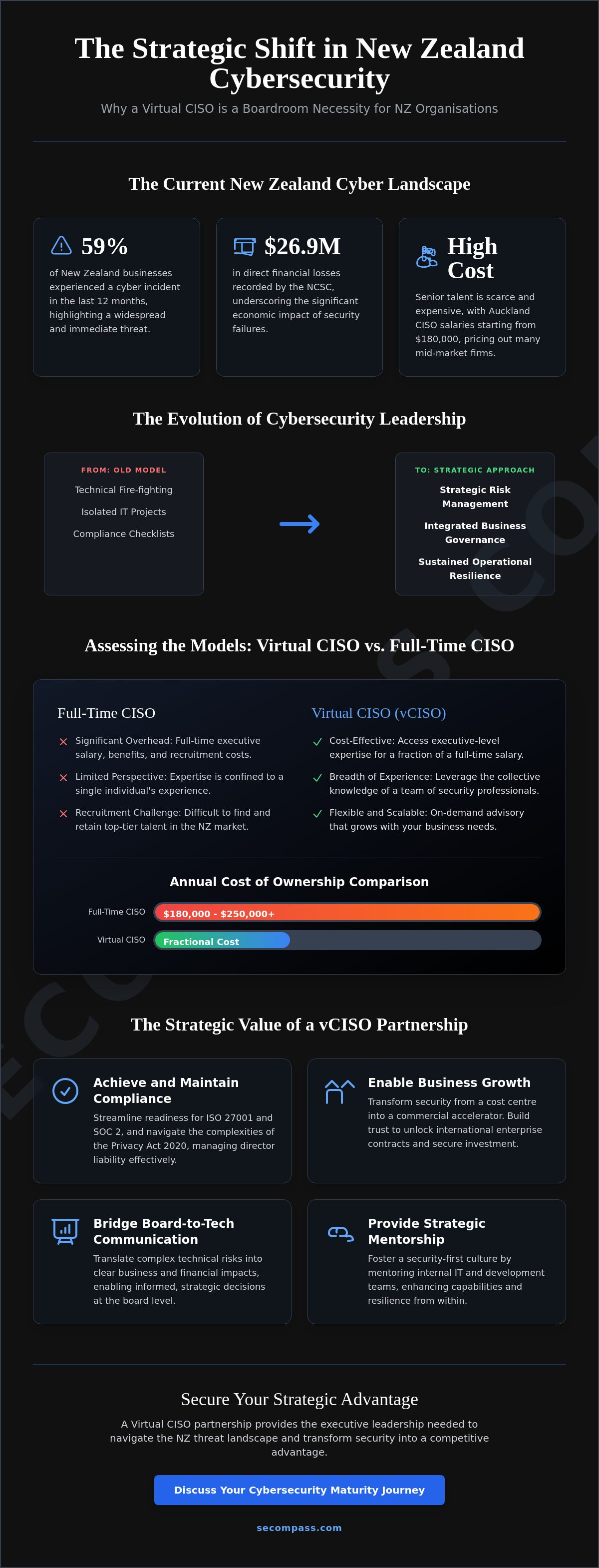
59% of New Zealand businesses experienced a cyber incident in the 12 months leading up to March 2026. This reality, coupled with the $26.9 million in direct financial losses recorded by the NCSC last fiscal year, has moved cybersecurity from the server room to the boardroom. You likely recognise that the pressure to prove security maturity is no longer just a technical requirement. It is a commercial necessity, especially when Trans-Tasman partners demand rigorous assurance or when navigating the complexities of the Privacy Act 2020 and the new IPP 3A requirements. Finding senior talent in Auckland to lead this strategy is increasingly difficult and costly.
Engaging a virtual CISO New Zealand provides your organisation with executive-level security leadership and a clear roadmap for ISO 27001 or SOC 2 readiness, all without the overhead of a full-time hire. We will explore how this strategic partnership delivers board-ready reporting, manages mounting director liability, and ensures your governance framework remains resilient against evolving threats. This guide details how to bridge the skills gap while maintaining the high level of assurance your stakeholders expect.
Key Takeaways
- Understand the transition from reactive technical management to proactive, strategic security leadership that supports long-term business goals.
- Discover how a virtual CISO New Zealand delivers executive-level oversight and regulatory assurance while significantly reducing the total cost of ownership.
- Learn how to leverage ISO 27001 and SOC 2 readiness as strategic assets to build trust with global partners and unlock new commercial opportunities.
- Identify the essential steps for aligning your security posture with the Privacy Act 2020 to manage director liability and ensure organisational resilience.
- Gain insights into integrating senior advisory services that bridge the gap between complex technical operations and board-level governance requirements.
Table of Contents
-
Assessing the Model: Full-Time CISO vs. Virtual CISO in 2026
-
Bridging the Gap: Integrating vCISO Services into Your Organisation
The Evolution of Cybersecurity Leadership in New Zealand
Leadership in New Zealand has reached a definitive turning point. For many years, security was viewed through a purely technical lens, often relegated to the IT department as a series of reactive fire-fighting exercises. This approach is no longer sustainable. The introduction of the Privacy Act 2020 and the more recent IPP 3A requirements in May 2026 have elevated cybersecurity to a core governance priority. Directors now face mounting personal liability, making the need for sophisticated risk management more urgent than ever before. This shift marks a transition from technical maintenance to strategic oversight.
What is a Virtual CISO (vCISO)?
A Chief Information Security Officer is traditionally a full-time executive responsible for an organisation's entire security posture. However, the virtual CISO New Zealand model offers a more flexible, board-level advisory service. Unlike a senior engineer who focuses on technical implementation, a vCISO operates as a strategic mentor. They provide high-level oversight on a retainer or project basis, ensuring that security initiatives align with broader business objectives. A vCISO is a strategic partnership that provides maturity and assurance through expert guidance rather than just technical support.
Why NZ Businesses are Moving to Fractional Leadership
The talent market in Auckland and Wellington is currently facing a significant "CISO Gap." With average salaries for full-time security leaders ranging from $180,000 to over $250,000, many mid-market firms find themselves priced out of the expertise they need. Fractional leadership allows these organisations to access top-tier talent on demand. This model is particularly effective for rapidly scaling firms that require a virtual CISO New Zealand to navigate the local threat landscape and the specific requirements of the New Zealand Information Security Manual (NZISM).
The evolution involves a transition across three key areas:
-
From technical "fire-fighting" to strategic risk management.
-
From isolated IT projects to integrated business governance.
-
From compliance checklists to sustained operational resilience.
Beyond Compliance: The Strategic Value of a vCISO
Viewing security through a purely regulatory lens often obscures its potential as a commercial accelerator. While compliance with the Privacy Act 2020 is mandatory, the true advantage of a virtual CISO New Zealand lies in their ability to transform security maturity into a market differentiator. For New Zealand firms looking to scale globally, a robust security posture is the key that unlocks international enterprise contracts. These organisations don't just want to know you're compliant; they want proof of sustained operational resilience.
A vCISO bridges the communication gap between technical teams and the boardroom. They translate complex vulnerabilities into business risks, allowing leadership to make informed decisions based on financial exposure rather than technical jargon. This level of Cybersecurity Leadership is essential during the due diligence process, especially for NZ startups seeking venture capital or preparing for acquisition. Investors increasingly scrutinise security frameworks as a primary indicator of long-term stability.
Enabling Business Growth through Trust
International partners frequently require evidence of ISO 27001 or SOC 2 readiness before signing agreements. A virtual CISO New Zealand streamlines this process by managing the complex documentation and control implementation required for these standards. Beyond closing deals, this matured posture often leads to more favourable terms with insurers, as demonstrated maturity reduces the perceived risk profile of the business. You can evaluate your current security maturity to identify where these commercial opportunities may be currently hindered by hidden gaps.
Strategic Mentorship for Internal Teams
Security is a cultural commitment rather than a one-off project. A vCISO acts as a strategic mentor for your existing IT and development teams, fostering a "security-first" mindset throughout the organisation. This involves more than just oversight; it includes organising targeted security awareness training and coaching staff to recognise that every employee plays a role in the firm's collective defence. This collaborative approach ensures that security becomes an embedded part of the organisational DNA, protecting the brand's reputation over the long term.
Assessing the Model: Full-Time CISO vs. Virtual CISO in 2026
The decision to hire a full-time security executive often hinges on a simple cost-benefit analysis. However, in 2026, the variables have shifted significantly. With full-time salaries for security leaders in New Zealand now averaging between $180,000 and $250,000, excluding recruitment fees and executive benefits, the financial commitment is substantial. For many organisations, the primary challenge isn't just the capital outlay; it's the scarcity of talent. Engaging a virtual CISO New Zealand allows a business to bypass the typical six-month recruitment cycle, providing immediate access to strategic leadership without the delay of a traditional search.
Most organisations reach a natural inflection point where the complexity of their regulatory environment or the scale of their operations requires dedicated oversight. Until that point, a fractional model provides the necessary governance maturity without the fixed overhead of a permanent hire. This approach ensures continuity of service, protecting the business from the "single point of failure" risk associated with a lone internal hire who may eventually move on to another role. It allows leadership to maintain a steady course while scaling their security operations in line with business growth.
Maximising ROI through Fractional Leadership
Accessing senior expertise on a fractional basis allows leadership to reallocate capital toward core operational initiatives. Rather than waiting for a permanent hire to understand the organisational culture, a virtual CISO New Zealand can begin addressing critical gaps in your ISO 27001 or SOC 2 readiness from day one. This model effectively provides seniority without the surcharge, allowing you to pay for high-level strategic output rather than just a physical presence in the office.
Gaining a Breadth of Perspective
A permanent hire is naturally focused on a single internal environment. In contrast, a vCISO brings insights gathered from across diverse industries and threat landscapes. This cross-pollination of knowledge means that a solution developed for a financial services firm in Melbourne can often be adapted to strengthen a technology provider in Auckland. By leveraging our presence across both New Zealand and Australia, SeComPass ensures that your strategy is informed by Trans-Tasman trends and emerging global standards. This broader view provides a level of assurance that is difficult to replicate with a single internal perspective.
Bridging the Gap: Integrating vCISO Services into Your Organisation
Integrating a virtual CISO New Zealand into your leadership structure is a methodical process that begins with a deep dive into your current state. This begins with a rigorous security posture assessment and gap analysis to identify where existing controls may fall short of international standards or local requirements. The objective is to align security goals with your broader business strategy, ensuring that risk management supports rather than hinders your operational objectives. This alignment transforms security from a technical hurdle into a core business enabler.
Establishing clear reporting lines to the Board and senior leadership is a priority during this phase. This ensures that security metrics are communicated in a way that highlights business impact rather than just technical vulnerabilities. By developing a prioritised roadmap, we focus on high-impact risk mitigation first, creating a foundation for ongoing stewardship. Regular review cycles ensure your organisation remains resilient as the threat landscape and your business requirements evolve.
Navigating Trans-Tasman Regulatory Requirements
For organisations operating across the ditch, the regulatory landscape is particularly complex. A virtual CISO New Zealand must harmonise the requirements of the NZ Privacy Act 2020 with the Australian Privacy Act. This includes managing data sovereignty issues and ensuring that third-party risk management (TPRM) protocols satisfy both jurisdictions. We ensure your cross-border data flows are secure and compliant, protecting your reputation and operational integrity in both markets.
The First 90 Days of a vCISO Engagement
The initial phase of an engagement focuses on delivering immediate value through "Quick Wins" that reduce your most pressing exposures. We simultaneously define your Governance, Risk, and Compliance (GRC) framework to provide long-term structure and clarity. By the end of the first 90 days, we establish the specific security metrics that matter to your stakeholders, providing a transparent view of your maturity journey. You can book a consultation to begin this integration process and secure your strategic roadmap.
Why SeComPass is the Strategic Partner for NZ Businesses
Navigating the complexities of the New Zealand security landscape requires a partner who understands local nuances while maintaining a global perspective. SeComPass serves as a "Wise Guide" for organisations seeking a virtual CISO New Zealand. Our dual-office presence in Auckland and Melbourne ensures that we provide grounded, local support for businesses with Trans-Tasman operations. This regional focus is complemented by deep expertise across internationally recognised frameworks, including ISO 27001, SOC 2, and NIST, allowing us to build governance structures that are both locally compliant and globally respected.
We view security and privacy not as technical hurdles, but as essential drivers for customer trust and market expansion. By focusing on systemic integrity and long-term resilience, we help firms transform their security posture into a competitive advantage. Our team brings a calm, authoritative presence to the boardroom, ensuring that leadership feels supported through every stage of their maturity journey.
Our Approach to Partnership
We don't operate as an outside vendor; instead, we integrate as a seamless extension of your leadership team. This collaborative model is built on "Quiet Expertise", where our value is demonstrated through steady progress and long-term stability. Whether your organisation requires a project-based engagement to achieve a specific certification or a retainer-based virtual CISO New Zealand for ongoing governance, our flexibility ensures that the engagement matches your specific needs. We prioritise clear communication and methodical execution, ensuring technical requirements are always framed within a business-centric context.
Ready to Secure Your Future?
Transitioning from a state of regulatory uncertainty to one of strategic assurance is a fundamental shift in how a business operates. By prioritising privacy and security assurance, you protect your reputation and unlock new commercial opportunities with global partners. We invite you to begin this transition with a confidential discussion about your security roadmap and long-term objectives. Speak with a SeComPass advisor about vCISO services today to establish the governance maturity your stakeholders and regulators expect.
Advancing Your Organisational Maturity and Resilience
The transition from reactive technical management to proactive governance is a critical milestone for any maturing firm. You've seen how security leadership now influences everything from international contract negotiations to director liability under the Privacy Act 2020. By engaging a virtual CISO New Zealand, your organisation gains the executive oversight required to navigate complex standards like ISO 27001 and SOC 2 without the friction of a long-term recruitment cycle.
SeComPass provides this strategic mentorship with over 20 years of experience in the field. With established offices in Auckland and Melbourne, we offer the Trans-Tasman perspective necessary for modern enterprise growth. We remain focused on providing the quiet expertise that stabilises your operations and builds lasting trust with your stakeholders. This approach ensures that technical requirements are always aligned with your broader commercial objectives.
Secure your strategic security leadership with SeComPass and begin your journey toward a more resilient future. We look forward to guiding your leadership team through the next phase of your security evolution and ensuring your governance framework is ready for the challenges ahead.
Frequently Asked Questions
What is the typical cost of a virtual CISO in New Zealand?
A virtual CISO is structured as a monthly retainer or a fixed-price project, providing a cost-effective alternative to the $180,000 to $250,000 annual salary of a full-time executive. The specific investment depends on the complexity of your regulatory environment and the level of strategic oversight required. This model allows organisations to access senior expertise while keeping operational expenditure predictable and aligned with their current growth phase.
How many hours a month does a vCISO usually work?
The engagement level for a virtual CISO New Zealand is flexible, often ranging from a few hours a week for ongoing governance to more intensive involvement during a certification push. Most organisations begin with a higher cadence during the initial gap analysis and roadmap development. Once your security framework is established, the role typically shifts into a steady rhythm of monthly reviews and board reporting to maintain maturity.
Can a vCISO help us achieve ISO 27001 certification?
Yes, a vCISO is specifically equipped to lead your organisation through ISO 27001 readiness and implementation. They oversee the development of your Information Security Management System (ISMS), coordinate the necessary internal audits, and ensure all controls are documented correctly for the final assessment. This strategic leadership ensures that the certification process is efficient and delivers genuine commercial value rather than just a badge of compliance.
Does a vCISO handle technical tasks like firewall configuration?
No, a vCISO operates at a strategic and board level rather than performing hands-on technical configurations. Their role is to define the security standards, manage risk, and provide oversight of the technical teams or vendors responsible for implementation. This clear separation between governance and execution ensures that your security strategy remains objective and focused on broader business outcomes.
What is the difference between a vCISO and a security consultant?
The primary difference lies in the depth of the partnership and the level of ongoing accountability. While a security consultant is typically engaged for a short-term, tactical project, a vCISO acts as a strategic mentor and a long-term member of your leadership team. They provide continuous stewardship and take ownership of your security roadmap, whereas a consultant usually delivers a specific output and then concludes the engagement.
How does a vCISO assist with NZ Privacy Act 2020 compliance?
A vCISO ensures your organisation meets all obligations under the Privacy Act 2020, including the new IPP 3A requirements that came into force on May 1, 2026. They implement the necessary privacy impact assessments and data handling protocols to manage indirect information collection risks. This proactive approach helps directors manage their personal liability while ensuring that the organisation's privacy practices meet the standards of the Privacy Commissioner.
Is a vCISO suitable for a small startup with a limited budget?
Fractional leadership is an ideal solution for startups that need to prove security maturity to win enterprise contracts but don't have the capital for a full-time hire. A virtual CISO New Zealand allows high-growth firms to build a resilient foundation from the outset. This provides the necessary assurance to investors and international partners during due diligence, helping the startup scale with confidence.
How does SeComPass manage Trans-Tasman security requirements?
SeComPass manages Trans-Tasman requirements by harmonising security and privacy frameworks across our Auckland and Melbourne offices. We ensure that your organisation complies with both the New Zealand and Australian Privacy Acts while addressing specific data sovereignty issues. This dual-market presence allows us to provide a unified governance strategy for firms operating across the Tasman, reducing complexity and ensuring consistent protection.